Showing posts with label robot. Show all posts

5/19/14

Robots Taking Care of Seniors - The Future is Now

Mark Turner
Mysterious World
05/19/2014

The future is here, or at least they're working on it. The somewhat spooky prospects of the elderly being cared for by automatons is quickly becoming a reality. A recent CNN story covered seniors who already have robot assisted help for daily tasks. 'Mr. Robin' is a mobile bot developed by GiraffPlus that has a touch screen tablet attached to it where the robots head would be. At an apartment in Italy where 94 year old Lea Mina Ralli resides, Mr. Robin monitors her vital signs and activity via remote sensors located around the home. This information is sent to her caretakers and if there is an emergency they can be notified imitatively. The tablet device on the android also makes it possible for her to connect with her family.

Though these advancements are remarkable and prove to be expensive for companies willing to develop them, it may be just a matter of time before something looking a lot like C3PO is making breakfast for your grandmother and taking out her trash.


Intelligent Robots Will Overtake Humans by 2100, Experts Say

Psychic Robot Bartender Knows When You Want It to Pour You a Beer (VIDEO)

A Brief History of Awesome Robots

In search of The REAL GODZILLA! - Monster Dinosaur Sightings in Modern Times

AREA 51 Whistle Blower Bob Lazar's First interview in many years - Still Standing by Story of Aliens & Crashed UFOs (VIDEO)

NEW BOOK details Top Secret UFO Crash Retrievals, Alien Bodies and Government Cover-ups

WATCH The Secret Mars Colony DOCUMENTARY

UFO WAVE USA: Mutual UFO Networks Sighting Statistics released for the month of April 2014

Ghost Attack - Caught on Video! Man Pushed and Dragged by a Dark Spirit

6/15/13

Immortality by 2035? (VIDEO)


Bob Pisani
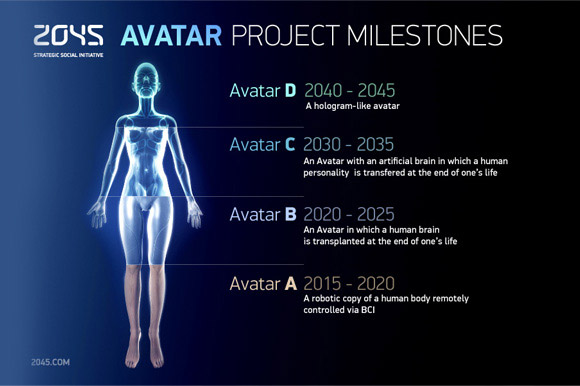
Image source: 2045.com

How's this for a weekend conference: Some of the smartest people in the world are gathering in New York to try to figure out how to build lifelike copies of humans ... to be eventually uploaded with the contents of a real human brain.

It's the brainchild of a Russian multimillionaire, Dmitry Itskov. ... And he says he's perfectly serious, and that it could be accomplished by 2035.


Crazy? The New York Times gave Itskov a front-page profile on its Sunday Business page a week and a half ago.

Story continues here: cnbc.com

Related stories . . . 

5/30/13

Psychic Robot Bartender Knows When You Want It to Pour You a Beer (VIDEO)


Will Oremus
Slate

What’s better than a robot that can serve you beer? How about a robot that can tell when you’re about to move your glass, so it doesn't accidentally pour the beer straight into your lap?

That’s the ambitious goal of computer scientists at Cornell’s Personal Robotics Lab, who equipped a PR2 robot with a Microsoft Kinect camera and a database of 3-D videos to teach it to anticipate human actions. So if you reach for your mug when it’s getting ready to pour you a brewski, it realizes that you might be about to move the mug—then waits until you've put it back before beginning to pour.

The artificial intelligence involved is akin to the algorithms Google uses to autocomplete your words when you start typing them into a search window on your computer. In this case, the robot watches you begin to move and develops a few hypotheses about where you’re most likely to move so that it can respond appropriately.


Story continues here: slate.com

Related stories . . .


5/13/13

A Brief History of Awesome Robots

Ryan Jacobs

In Kevin Drum's latest feature, he imagines a bleak future where robots begin taking all of our jobs. Though he predicts this will happen about three decades from now, the concept obviously isn't new. The word "robot" first appeared in a 1920s Czech play (see below), which concludes with human destruction. The plot line started to seem more realistic when robots began performing complex industrial tasks. By 1961, a giant robot arm called Unimate took a welding job on the General Motors factory floor. Throughout the last century, robots—both imaginary and real—have fascinated us with their skills, quirks, and eerie human-like qualities. The timeline below highlights some of the most memorable machine moments and personalities.


1921 - Rossum's Universal Robots
A scene from a R.U.R production. Wikipedia


The word robot first appeared in 1921 when Czech playwright Karel Capek's drama R.U.R.(Rossum’s Universal Robots) premiered in Prague. The story follows the employees of a factory producing cheap and efficient robotic labor. While Capek is widely credited for the word's invention, he attempted to correct the record in a 1933 article for the Czech newspaperLidove noviny:

It was like this: the idea for the play came to said author in a single, unguarded moment. And while it was still warm he rushed immediately to his brother Josef, the painter, who was standing before an easel and painting away at a canvas till it rustled.

"Listen, Josef," the author began, "I think I have an idea for a play." "What kind," the painter mumbled (he really did mumble, because at the moment he was holding a brush in his mouth). The author told him as briefly as he could. "Then write it," the painter remarked, without taking the brush from his mouth or halting work on the canvas. The indifference was quite insulting.

"But," the author said, "I don't know what to call these artificial workers. I could call them Labori, but that strikes me as a bit bookish."
"Then call them Robots," the painter muttered, brush in mouth, and went on painting. And that's how it was. Thus was the word Robot born; let this acknowledge its true creator.

The Czech word "robota" is roughly translated as servitude or drudgery. Tragically, the robots go far beyond their servant role, eliminating every human on Earth except the factory's old architect, Mr. Alquist. With the building manuscripts torched and his mind going, Alquist hopes the machines can figure out how to reproduce themselves and live on as "the shadow of man."

1927 - Maria

In a utopian city in the future, workers toil below ground to keep things running smoothly above. With a potential worker uprising looming, the city's founder instructs his lackey scientist to construct a robot that looks like one of the workers, Maria, so it can crush the rebellion. The metallic star of German filmmaker Fritz Lang's famous silent film Metropolisinspired many other movie depictions of robots, including C-3PO


Story continues at: Mother Jones


Related stories: 

Russian Billionaire Dmitry Itskov Plans on Becoming Immortal by 2045 (VIDEO)

Intelligent Robots Will Overtake Humans by 2100, Experts Say

Star Trek's Warp Drive May Actually Work (VIDEO)

Mars One says 80,000 have applied for one-way mission to red planet (Video)

5/10/13

Russian Billionaire Dmitry Itskov Plans on Becoming Immortal by 2045 (VIDEO)

Mother Board

By Fruzsina Eördögh

Dmitry Itskov wants to live forever. The 32-year-old Russian billionaire and media mogul thinks he can do this by building himself (and everyone) an android body by the year 2045.

There are a few flaws to Itskov’s idea, but that hasn’t stopped more than 20,000 people from publicly supporting the site outlining his plan of using android bodies for immortality. Dubbed the 2045 Initiative, Itskov is selling his idea as the "next step" in human evolution, or "neo-humanity," as he refers to it.

It doesn't stop with android bodies, either. The 2045 folks are also calling for a new religion and set of ethics because they don’t believe any of the current ones can handle the societal implications of living forever—as most of the current ones have you dying first in order to achieve immortality.

Itskov has also gone ahead and registered his own political party in Russia called “Evolution 2045.”

Read full story: Mother board

Related Stories . . . 

5/9/13

Intelligent Robots Will Overtake Humans by 2100, Experts Say

CREDIT: jimmi | Shutterstock
Tia Ghose, LiveScience


Are you prepared to meet your robot overlords?

The idea of superintelligent machines may sound like the plot of "The Terminator" or "The Matrix," but many experts say the idea isn't far-fetched. Some even think the singularity — the point at which artificial intelligence can match, and then overtake, human smarts — might happen in just 16 years.

But nearly every computer scientist will have a different prediction for when and how the singularity will happen.

Some believe in a utopian future, in which humans can transcend their physical limitations with the aid of machines. But others think humans will eventually relinquish most of their abilities and gradually become absorbed into artificial intelligence (AI)-based organisms, much like the energy making machinery in our own cells. [5 Reasons to Fear Robots]

Singularity near?

In his book "The Singularity is Near: When Humans Transcend Biology" (Viking, 2005), futurist Ray Kurzweil predicted that computers will be as smart as humans by 2029, and that by 2045, "computers will be billions of times more powerful than unaided human intelligence," Kurzweil wrote in an email to LiveScience.

"My estimates have not changed, but the consensus view of AI scientists has been changing to be much closer to my view," Kurzweil wrote.

Bill Hibbard, a computer scientist at the University of Wisconsin-Madison, doesn't make quite as bold a prediction, but he's nevertheless confident AI will have human-level intelligence some time in the 21st century.

"Even if my most pessimistic guess is true, it means it's going to happen during the lifetime of people who are already born," Hibbard said.

But other AI researchers are skeptical.

"I don't see any sign that we're close to a singularity," said Ernest Davis, a computer scientist at New York University.

While AI can trounce the best chess or Jeopardy player and do other specialized tasks, it's still light-years behind the average 7-year-old in terms of common sense, vision, language and intuition about how the physical world works, Davis said.

For instance, because of that physical intuition, humans can watch a person overturn a cup of coffee and just know that the end result will be a puddle on the floor. A computer program, on the other hand, would have to do a laborious simulation and know the exact size of the cup, the height of the cup from the surface and various other parameters to understand the outcome, Davis said. [10 Cool Facts About Coffee]